

Choosing the right orthodontic treatment is not just about straightening your teeth; it’s about balancing appearance, comfort, cost, and long-term results. With multiple options available today, many patients feel overwhelmed trying to decide whether Invisalign is the right path or whether a more traditional approach would serve them better.
This guide breaks everything down in a straightforward, practical way. By the end, you’ll have a clear sense of which option fits your dental condition, lifestyle, and priorities before you even step into a consultation.
Understanding Your Orthodontic Needs
Before comparing treatments, it’s important to understand why you need orthodontic care. Every smile is different, and the right solution always starts with your specific dental condition.
- Crowded or overlapping teeth
- Gaps between teeth
- Overbite, underbite, or crossbite
- Jaw alignment problems
In mild cases, cosmetic alignment may be the primary goal. In more complex cases, however, orthodontic treatment is necessary for functional improvement, including better chewing, clearer speech, and stronger long-term oral health. Identifying where your case falls on this spectrum is the first step to choosing the right solution.
What is Invisalign and How Does It Work?
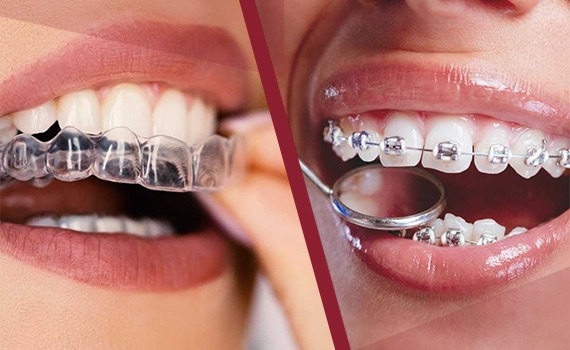
Invisalign uses a series of clear, removable plastic aligners digitally designed using 3D scanning technology, ensuring a precise and customized fit. Each tray is worn for 1-2 weeks, applying controlled force to gradually shift teeth into position, with no wires, no brackets, and no tightening appointments.
Why do people choose it?
- Nearly invisible in photos and meetings
- Removable for eating and brushing
- No metal wires causing irritation
- Minimal lifestyle disruption
Points to keep in mind
- Must wear 20–22 hours per day
- Requires strong daily discipline
- Not ideal for highly complex cases
Traditional metal braces
Considered the gold standard for decades, metal braces use brackets bonded to teeth and connected by wires that are periodically tightened to guide precise tooth movement. They work 24/7 with no effort from the patient.
Advantages
- Suitable for all misalignment levels
- Highly precise tooth control
- No compliance dependency
- Most affordable option
Challenges
- Visible appearance
- Discomfort after adjustments
- Dietary restrictions apply
- Extra cleaning required
Ceramic braces
Ceramic braces function identically to metal braces but use tooth-colored or clear brackets that blend naturally with enamel, making them far less noticeable in daily life and photos.
Advantages
- Blend naturally with teeth
- Effective for moderate to complex cases
- Same precision as metal braces
Challenges
- More expensive than metal braces
- Brackets can stain without care
- Slightly more fragile
Lingual braces
Lingual braces are attached to the back (tongue-side) surfaces of teeth, making them completely invisible from the front. They offer the effectiveness of fixed braces without any visible hardware at a premium price point.
Advantages
- Total invisibility from the front
- Fixed treatment with no removal needed
- Effective for complex cases
Challenges
- Initial tongue irritation and speech adjustment
- Most expensive option
- Fewer qualified providers
- Cleaning can be difficult
Key Factors That Shape Your Choice
Choosing between Invisalign and other options becomes clearer when you evaluate these six factors honestly against your own situation.
Severity of your dental issue
Mild to moderate problems, small gaps, minor crowding, and slight rotations are where Invisalign performs best, offering a faster and more comfortable experience. Complex cases involving severe crowding, significant bite issues, or jaw misalignment typically require traditional or lingual braces, which give orthodontists more precise, direct control over tooth movement.
Your lifestyle and daily routine
Invisalign is ideal for those in public-facing roles, professionals who attend frequent meetings, or anyone who values flexibility at mealtimes. But it demands consistent wearing for 20 to 22 hours every single day. If you know you’re forgetful or inconsistent, fixed braces deliver a “set-and-forget” solution that works continuously without any effort.
Aesthetic expectations
If invisibility is non-negotiable, Invisalign or lingual braces are your options. If you want a good balance between appearance and cost-effectiveness, ceramic braces offer a discreet middle ground. If results matter more than appearance during treatment, traditional metal braces remain the most reliable and affordable path.
Budget considerations
Cost varies significantly based on case complexity and duration. Metal braces are the most affordable starting point. Ceramic braces sit in the mid-range. Invisalign and lingual braces are both premium-priced options. Always factor in consultation fees, follow-up visits, and the cost of retainers after treatment ends; these add up regardless of which route you choose.
Comfort and convenience
Invisalign’s smooth plastic aligners cause significantly less soft-tissue irritation than metal brackets and wires, and brushing and flossing remain completely normal. Braces can cause soreness after each adjustment appointment and require special cleaning tools and techniques to maintain good oral hygiene around the brackets.
Treatment duration
Invisalign typically runs 6 to 18 months for mild cases, with faster results when compliance is high. Traditional braces generally run 12 to 24 months, or longer for more complex issues. Critically, Invisalign timelines can extend significantly when aligners are not worn consistently; this is the single biggest variable in how quickly treatment completes.
Deciding between Invisalign and other orthodontic options ultimately comes down to your priorities and dental condition.
- If you value appearance, flexibility, and comfort, Invisalign is a strong choice.
- If your case is complex or you want guaranteed results without effort, traditional braces are more reliable.
The most important step is a professional consultation. An experienced orthodontist can evaluate your teeth, explain realistic outcomes, and guide you toward the best treatment for your smile.
At Braceport Dentistry, patients have access to the complete range of orthodontic treatments in HSR Layout, Bangalore, so your choice is never limited by what the clinic can provide, only by what is genuinely best for your smile.
What Sets Braceport Dentistry Apart
Full treatment range, one clinic
From Invisalign to fixed braces, every option is available, so recommendations are based on your needs, not on what the practice happens to offer.
Personalised treatment planning
Every patient receives a thorough clinical assessment covering dental condition, bite, bone structure, and lifestyle before any treatment recommendation is made.
Conveniently located in HSR Layout
Serving patients across HSR Layout and surrounding areas of Bangalore, easy to reach for regular appointments throughout your treatment journey.
Guided from consultation to completion
Our orthodontic team supports you at every stage from your first consultation and treatment design through to final retainers and long-term maintenance.
Ready for your best smile?
Book a consultation at Braceport Dentistry and let our orthodontic team evaluate your case, walk you through every option, and help you make the right decision with confidence.